
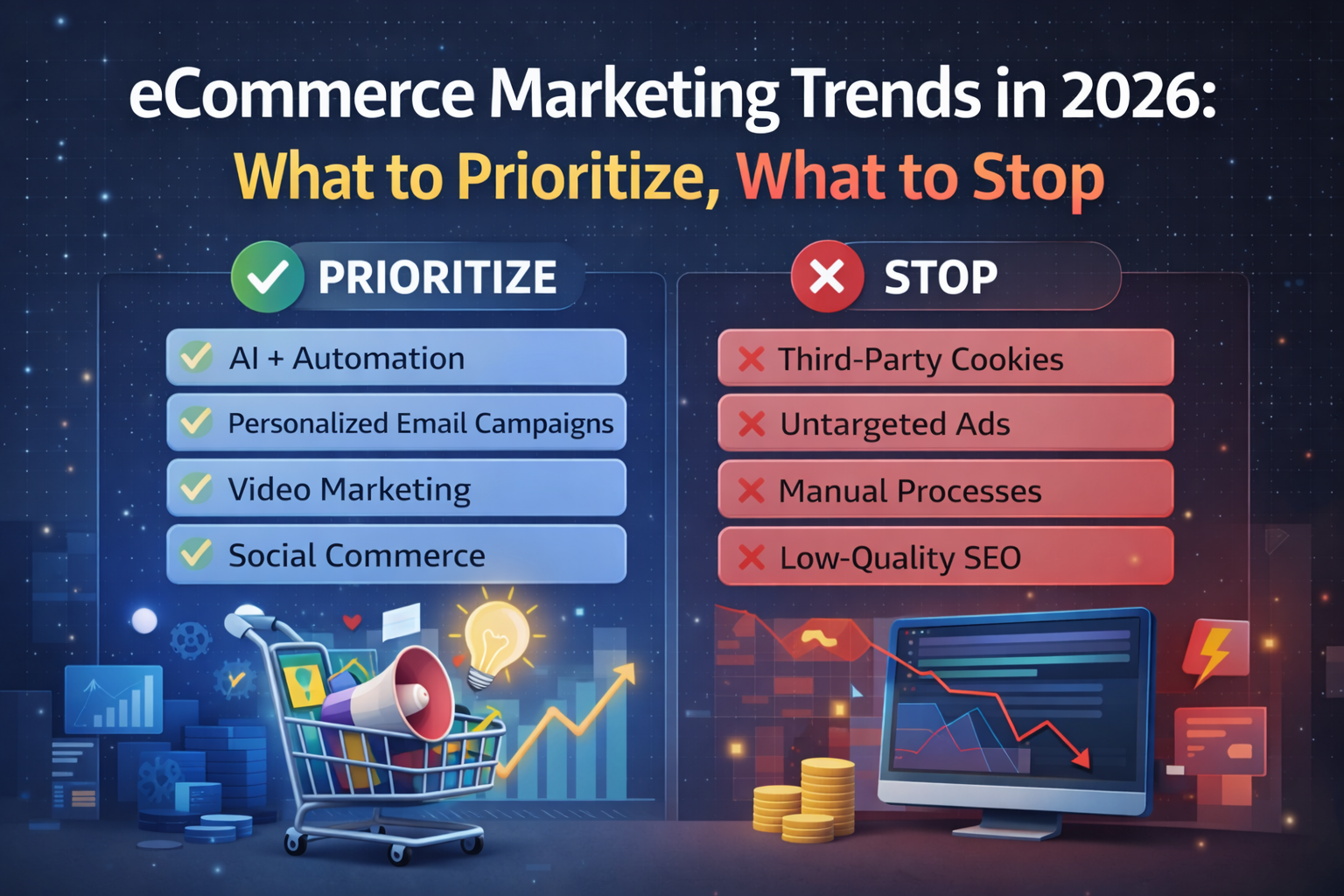
eCommerce marketing trends in 2026 reward brands that treat marketing as an operating system: clean product data, measurable incrementality, and trust-first creative that can travel across paid, owned, and marketplace channels. The winners look less like “campaign factories” and more like disciplined merchandisers with tight measurement and fast feedback loops.
In 2026, the most reliable growth comes from connecting product data, consented customer data, and measurement into one system, then using AI to execute within clear guardrails.
A useful way to read the trends is: what reduces wasted spend, what increases conversion, and what prevents brand risk from compounding quietly.
What’s actually changing in 2026
Marketing is shifting from “traffic acquisition” to “profitably converting demand that already exists,” because demand is steady but attention is fragmented. When the market is noisy, the easiest lift is often conversion quality, not reach volume.
US eCommerce is also large enough that small percentage shifts are meaningful. In the Quarterly Retail E-Commerce Sales report, Q3 2025 e-commerce sales were estimated at $310.3B (seasonally adjusted) and represented 16.4% of total retail sales, with year-over-year growth for e-commerce outpacing total retail. That “share of wallet” context matters because it frames 2026 as an efficiency contest, not a land grab.
Marketing implications show up in three places:
- Product discovery is less linear.
Buyers jump from TikTok to Amazon to Google to email to a friend’s screenshot. Channel attribution that assumes one “source of truth” will undercount reality. - Merchandising and marketing merge.
Pricing, availability, delivery promise, and returns policy convert or kill demand before creative does. - Measurement is now a product requirement.
If revenue can’t be attributed cleanly enough to make budget decisions, spend becomes political, not performance-driven.
A practical decision rule: if a tactic depends on perfect attribution to look good, treat it as risky. Tactics that still look good under conservative measurement are the ones to scale.
At-a-glance shifts that show up in budgets
| 2026 shift | What drives it | Marketing move that matches |
|---|---|---|
| More spend pushed to “owned” | Rising acquisition costs and shaky tracking | Email/SMS lifecycle, site personalization tied to inventory |
| More marketplace gravity | Amazon/Walmart-style intent and fast fulfillment | Better catalog content, reviews flywheel, retail media |
| More creative volume, shorter shelf life | Platform feeds reward freshness | Modular creative system, rapid testing cadence |
| More scrutiny on claims and endorsements | Regulators and platforms | Compliance checks baked into workflow |
AI becomes a production layer, not a strategy
AI is everywhere in 2026, but the durable advantage is not “using AI.” It’s having data and rules that let AI do useful work without drifting into brand-damaging output.
The safest, highest-return uses look like this:
- Merchandising support:
product title variants, attribute completion, bundling ideas, taxonomy cleanup - Creative versioning:
turning one concept into many formats (short video hooks, captions, email blocks) - Customer support deflection:
order status, returns workflow, product selection assistance - Bidding and budget execution:
automation that follows guardrails and business constraints
The fragile uses look like this:
- Unreviewed claims:
performance claims, “best” statements, health/fitness claims, compatibility claims - Uncontrolled personalization:
offers that vary by user without clear rules and QA - Synthetic UGC without disclosure:
content that reads like a human review but isn’t
Governance is not theoretical anymore. A workable baseline is to treat AI outputs like financial outputs: they need controls, monitoring, and accountability. NIST’s AI Risk Management Framework is a practical reference for setting guardrails (govern, map, measure, manage) so teams can move fast without turning speed into risk.
A simple “AI guardrail” checklist for eCommerce marketing
- Source-of-truth fields:
titles, ingredients/materials, compatibility, shipping/returns terms come from controlled data, not free text - Review gates:
any claim that could be disputed gets human review before publication - Logging:
prompts, inputs, and outputs stored for audit and post-mortems - Fallback modes:
when confidence is low (or data is missing), AI suggests questions rather than asserting facts
In practice, the brands that scale AI without chaos run “structured creativity”: tight inputs, clear constraints, fast outputs.
Measurement moves from attribution to incrementality
The measurement trend that matters most in 2026 is the slow death of “one dashboard tells the truth.” Cross-device behavior, platform walled gardens, and privacy controls mean last-click attribution is frequently wrong in direction, not just magnitude.
Three measurement patterns are replacing it:
- Incrementality testing:
holdouts, geo tests, lift tests, and “stop/start” experiments - Modeled measurement:
marketing mix modeling (MMM) and blended attribution that is directionally correct - Server-side and first-party tagging:
cleaner event collection that survives browser limits better than pure client-side setups
This changes decisions. Instead of arguing which channel “gets credit,” the question becomes: which spend produces profitable lift when measured conservatively?
| Situation | What tends to work | What tends to break |
| High spend across many channels | MMM + channel lift tests | Last-click ROAS as budget allocator |
| One or two paid channels dominate | Platform lift tests + holdouts | Assuming platform-reported conversions are incremental |
| Heavy returning-customer revenue | Cohort/LTV tracking + lifecycle testing | Counting returning orders as “paid acquisition wins” |
| New product launches | Geo tests + creative-level experiments | Optimizing only for cheapest CPA |
Creator, UGC, and reviews face stricter trust requirements
2026 keeps pushing commerce toward creator-led discovery, but the trust bar is higher.
The biggest shift is not a new platform feature; it’s enforcement risk and credibility risk when endorsements look misleading.
If marketing uses reviews, testimonials, affiliate content, or influencer posts, compliance can’t be an afterthought.
The FTC’s
endorsements, influencers, and reviews guidance
lays out expectations around truthful endorsements, disclosure, and review integrity.
This affects day-to-day decisions:
- Disclosure is part of creative QA:
If a post is incentivized, the disclosure can’t be buried or ambiguous. - Review generation needs process integrity:
Any system that could be interpreted as suppressing negatives or boosting positives invites trouble. - UGC can’t be treated as “free claims”:
If a creator says it, the brand still owns the risk when it’s used in ads.
What creator programs are becoming in 2026
- More whitelisting and Spark-style amplification:
Paid distribution for creator-originated content. - More rights-managed asset libraries:
Clear usage terms, expiration rules, and defined channel scope. - More performance-linked economics:
Hybrid structures such as flat fee + tracked performance. - More “real customer” content:
Content that looks like a normal person using the product — because that is what audiences trust.
A practical guardrail:
Any claim in creator content that would be unacceptable on a product detail page is unacceptable in an ad — even if a creator said it.
Creator, UGC, and reviews face stricter trust requirements
2026 keeps pushing commerce toward creator-led discovery, but the trust bar is higher. The biggest shift is not a new platform feature; it’s enforcement risk and credibility risk when endorsements look misleading.
If marketing uses reviews, testimonials, affiliate content, or influencer posts, compliance can’t be an afterthought. The FTC’s endorsements, influencers, and reviews guidance lays out expectations around truthful endorsements, disclosure, and review integrity.
This affects day-to-day decisions:
- Disclosure is part of creative QA.
If a post is incentivized, the disclosure can’t be buried or ambiguous. - Review generation needs process integrity.
Any system that could be interpreted as suppressing negatives or boosting positives invites trouble. - UGC can’t be treated as “free claims.”
If a creator says it, the brand still owns the risk when it’s used in ads.
What creator programs are becoming in 2026
- More whitelisting and Spark-style amplification
(paid distribution for creator-originated content) - More rights-managed asset libraries
(clear usage terms, expiration, channel scope) - More performance-linked economics
(hybrids: flat fee + tracked performance) - More “real customer” content
that looks like a normal person using the product, because that is what audiences trust
A practical guardrail: any claim in creator content that would be unacceptable on a product detail page is unacceptable in an ad, even if a creator said it.
Trend priorities by constraint
The most expensive mistake in 2026 is copying a trend without matching it to constraints. A lean DTC brand and a high-volume retailer can both “do AI,” but the correct version of “AI” differs.
Priority map
| Constraint | Trend to prioritize | What success looks like in 90 days |
|---|---|---|
| Lean brand, limited headcount | Lifecycle revenue + creative system | Fewer promos, higher repeat rate, faster creative testing |
| Growth brand with rising CAC | Incrementality + product feed quality | Spend shifts to channels with verified lift |
| High-volume catalog | Catalog governance + automation | Fewer feed errors, better on-site search, lower returns |
| Marketplace-heavy sales | Retail media + review flywheel | Better share of search, improved conversion on listings |
| Premium pricing / brand risk | Trust-first creator strategy | Lower claim risk, higher content reuse value |
Two constraint-based decisions are showing up repeatedly:
If a brand has limited budget, prioritize retention mechanics before scaling acquisition
This is not a moral argument for email; it’s math. If contribution margin is tight, paying for “new customer” traffic that converts once is a fragile model. The 2026 version of retention is not more campaigns; it’s fewer messages with tighter segmentation, replenishment timing, and post-purchase education that reduces returns.
Tactically, that looks like tighter welcome and abandon flows, better post-purchase sequences, and fewer sitewide discounts that train buyers to wait.
If a brand has strong demand but weak conversion, prioritize the commerce layer
In practice, many “marketing problems” are product page problems: unclear shipping times, confusing sizing, lack of social proof, mismatched imagery, or a checkout that breaks on mobile. The 2026 trend is treating conversion work as a marketing multiplier, because it improves every channel at once.
A simple decision rule: when paid spend rises and conversion rate falls, inspect inventory depth, delivery promise, and returns friction before changing targeting.

Ajay Mistry
 Verified Google Merchant Center Compliance Specialist

Ajay Mistry is a Google Merchant Center Compliance Specialist with deep expertise in resolving account suspensions, correcting misrepresentation issues, and building policy-compliant eCommerce advertising systems. He specializes in Google Merchant Center, Performance Max (PMax), GA4 tracking, and Google Tag Manager, helping businesses achieve stable approvals, accurate data, and scalable growth through strict adherence to Google guidelines.